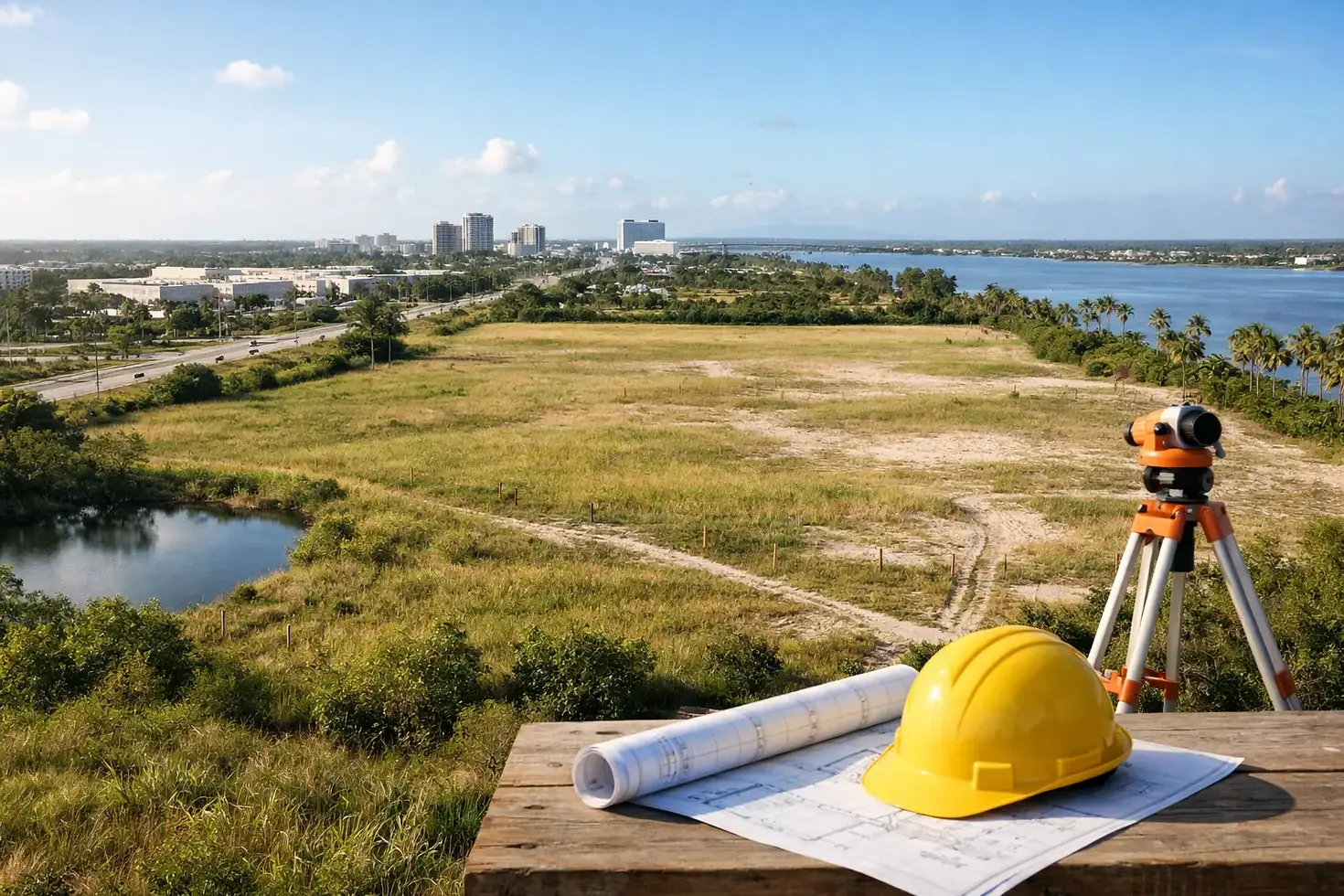
Commercial Land for Development Florida
- eracommercialgroup
- Jun 2
- 6 min read

A parcel can look like a winner from the road and still fail under real underwriting. That is the central issue with commercial land for development Florida investors and developers are reviewing right now. Strong traffic counts, visible frontage, and a growth corridor story mean very little if entitlement risk, utility constraints, stormwater requirements, or inflated basis wipe out the deal before vertical construction starts.
Florida continues to attract population, capital, and business relocation, but development land is not a broad, one-size-fits-all asset class. A retail outparcel in Estero trades on a different logic than industrial land near I-75, and both are very different from multifamily sites in Cape Coral or mixed-use opportunities in Naples. Sophisticated buyers do not just ask whether land is available. They ask whether the site can be executed at the right cost, in the right timeline, with the right exit.
What drives commercial land for development in Florida
The first filter is not price. It is demand alignment. Land only has value in development terms when the future use matches actual market absorption, local planning direction, and infrastructure capacity. In Southwest Florida, that usually means starting with migration trends, household formation, job growth, business expansion, and transportation patterns rather than simply looking for the cheapest dirt.
This matters because Florida has multiple growth stories happening at once. Some submarkets are supporting neighborhood retail because rooftops are expanding faster than service inventory. Others are seeing demand for industrial service bays, warehouse product, medical office, self-storage, or multifamily. A site that works for one use may be completely mispositioned for another, even if both sit within the same county.
The strongest land acquisitions are usually built on a clear use thesis. That thesis should explain who the eventual tenant, buyer, or end user will be, what competing supply looks like, and why the timing supports execution. Without that, land becomes speculation dressed up as strategy.
The real underwriting behind commercial land for development Florida buyers pursue
A serious land acquisition starts with basis discipline. If the land price leaves no room for entitlement costs, site work, financing carry, impact fees, and vertical margin, the deal is already compromised. Florida buyers who perform well over time are not simply aggressive. They are precise.
Zoning and future land use are the next major checkpoints. Existing zoning may allow the intended use by right, require a rezoning, or permit development only through a conditional or planned process. That distinction changes risk dramatically. A site that appears underpriced may simply be reflecting political uncertainty or approval complexity.
Utilities are often where optimistic pricing breaks apart. Water and sewer availability, lift station requirements, offsite improvements, road access, drainage, and stormwater retention can materially alter the total project cost. In some cases, the dirt is the inexpensive part of the deal and the infrastructure burden is what makes the project uneconomic.
Environmental and physical due diligence also need tighter scrutiny in Florida than many out-of-state buyers expect. Wetlands, flood zone exposure, protected species concerns, soil conditions, and mitigation obligations can all affect the developable footprint. A 10-acre site is not necessarily a 10-acre development site. The usable acreage after buffers, setbacks, retention, and environmental limitations is what matters.
Then there is timing. Carrying land through entitlements, engineering, and approvals can take longer than projected, especially when municipal review cycles are backlogged or agency comments require redesign. Time is not a side variable. It is part of basis.
Why location means more than frontage
Many land listings are marketed around visibility, hard corner positioning, or traffic counts. Those factors matter, but they are only part of the location equation. Good commercial land is defined by how efficiently it converts into a functioning project.
For retail, that means access, demographics, co-tenancy patterns, and whether daily-needs demand is already met nearby. For industrial, truck routes, labor access, and functional site layout can matter more than pure visibility. For multifamily, developers are weighing school patterns, employment drivers, insurance considerations, and competing pipeline. For owner-user sites, practical issues like parking ratios, ingress, and municipal compatibility often carry more weight than headline exposure.
In Southwest Florida, corridor positioning is especially important. Growth often follows infrastructure expansion, residential development, and shifts in consumer patterns. A site that looks secondary today may have strong forward value if it sits in a corridor with credible near-term population growth and constrained competing land. On the other hand, a highly visible parcel can still underperform if nearby demand has already been overserved.
Pricing land correctly is harder than most sellers think
Land valuation tends to suffer from two recurring errors. The first is pricing based on adjacent asking prices instead of closed transactions adjusted for entitlement status, utility readiness, and usable density. The second is assuming future upside should be fully paid for today by the buyer.
Sophisticated buyers do not underwrite land based on hope. They underwrite it based on residual value, replacement cost logic, expected yield, and realistic development timelines. If a seller prices a site as though approvals are complete, infrastructure is in place, and end-market demand is guaranteed, the property usually sits.
That does not mean sellers should discount quality land. It means positioning has to be credible. The market responds best when the pricing story is supported by zoning context, utility information, concept planning, and a clear narrative around the highest and best use. Exposure also matters. A well-marketed land offering reaches developers, investors, and owner-users differently than a generic listing pushed out with minimal analysis.
Off-market opportunities can create an edge, but not always a discount
Many buyers looking for commercial land for development Florida opportunities assume off-market automatically means cheaper. That is not always how it works. Off-market transactions can produce better pricing in some situations, but their real advantage is often reduced competition, more flexible structuring, and access to parcels that would never appear in broad public channels.
For developers and investors, off-market sourcing can be especially valuable when assembling land, pursuing confidential positioning moves, or targeting ownership groups that are open to selling but not actively marketing. The trade-off is that off-market inventory typically requires stronger local relationships, faster evaluation, and cleaner execution. There is less room for vague interest or slow diligence organization.
This is where a data-driven brokerage and advisory process matters. The best opportunities are not just found. They are filtered. The market does not reward buyers for seeing more land. It rewards them for identifying the parcels that can actually convert into profitable projects.
Common mistakes in Florida land deals
The most expensive land mistakes are usually made before the contract is signed. Buyers sometimes overestimate density, underestimate site work, or assume rezoning is procedural when it is actually uncertain. Sellers often bring land to market without enough support material, which leads to weak buyer confidence and slower pricing discovery.
Another common problem is forcing a use onto a site because that is what worked elsewhere. Florida is not one market. Naples, Fort Myers, Cape Coral, Port Charlotte, and Punta Gorda all behave differently. Land strategy should reflect local absorption, municipal posture, and the competitive pipeline.
There is also a tendency to treat land like a passive appreciation play with no expiration pressure. In reality, rising taxes, holding costs, approval delays, and changing capital markets can shift the economics quickly. A deal that looked attractive eighteen months ago may need a completely different structure today.
What serious buyers and sellers should do next
For buyers, the right first step is not making more offers. It is tightening acquisition criteria. Define the target use, basis range, entitlement tolerance, utility requirements, and exit strategy before evaluating inventory. Then underwrite each site against those standards with discipline.
For sellers, the best move is preparation. Before testing the market, organize zoning details, surveys, utility status, environmental information, concept plans if available, and a defensible pricing framework. Better information attracts better buyers and shortens the path to credible offers.
In a market as active and nuanced as Southwest Florida, land does not trade on surface-level marketing alone. It trades on clarity, positioning, and the ability to convert uncertainty into an actionable deal. Firms such as ERA Commercial Group operate in that gap between listing and execution, where local intelligence and real underwriting tend to make the difference.
The best land deals in Florida are rarely the ones with the loudest story. They are the ones where the numbers, approvals, timing, and end use line up tightly enough to give the buyer room to win.


Comments